Bilingual Website Design in Southern California: When English + Spanish Actually Matters
A bilingual website can be a real advantage for a Southern California business. It can also become twice the content and twice the maintenance for very little benefit.
The right question is not whether every Southern California website should be bilingual. It is whether a meaningful part of this business's customer journey already happens in both English and Spanish.
If the answer is yes, the second language should be treated like a real product experience—not a translation widget.
When bilingual is worth doing
I would consider a bilingual site when customers regularly ask for Spanish, staff already serve customers in Spanish, sales conversations happen in both languages, important intake is already bilingual, or the company is intentionally expanding into that audience.
Law firms, event businesses, home services, real estate, consultants, and local professional services can all fall into this category.
But the decision should come from the business. Do not add Spanish because it sounds good in a proposal and then never maintain it.
Translation is the easy part
The hard part is architecture.
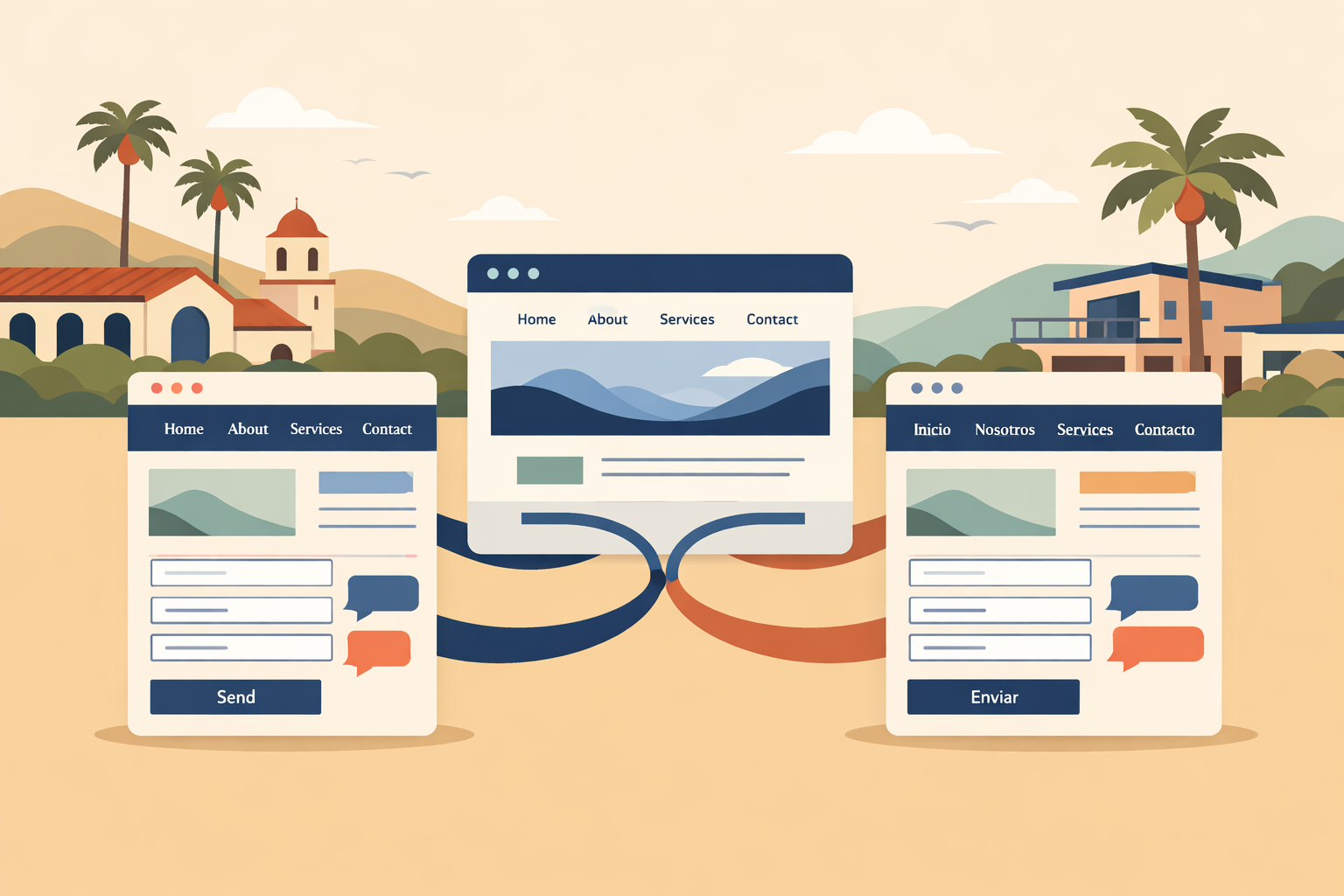
A complete bilingual website needs decisions around URLs, navigation, language switching, metadata, forms, validation messages, confirmation emails, images with text, blog content, legal disclaimers, staff bios, service pages, search indexing, and future updates.
If the English homepage changes next month, who updates the Spanish one?
That operational question matters more than the initial translation.
Treat both languages as first-class
A common pattern is a complete, polished English site and a Spanish version that is shorter, older, and missing pages.
That creates a strange trust signal.
If the Spanish experience is important enough to build, core pages should feel intentional: homepage, services, about, contact, intake, and key FAQs.
Not every English article needs a Spanish copy. The important part is that the customer journey works.
IRVING INPUT OPPORTUNITY: Add a concrete example from one of your bilingual builds where the Spanish experience changed navigation, form design, or page structure rather than simply changing text.
Use separate URLs for important pages
For meaningful bilingual content, I generally want each language to have its own crawlable URL instead of swapping all content on one URL using client-side state.
A common structure looks like /services and /es/servicios, or /en/services and /es/servicios.
Separate URLs make it easier to share the correct language, manage metadata, track performance, maintain internal links, and give search engines a clear relationship between pages.
Consistency matters more than the exact folder pattern.
Do not translate keywords mechanically
Search behavior is not always a direct translation.
The phrase an English-speaking customer uses may not be the phrase a Spanish-speaking customer naturally uses. That can affect service names, headings, FAQs, navigation labels, article ideas, and calls to action.
You are still writing for people first.
Forms are part of the language experience
If the page is in Spanish but the form is still in English, the experience feels unfinished.
Think through labels, helper text, validation errors, success messages, automated email confirmations, and appointment instructions.
The language experience should continue until the next human step.
Be careful with automatic translation
Automatic translation tools and AI are useful. I use AI constantly.
But important customer-facing content should still be reviewed by someone who understands the language and the business context.
A technically correct translation can sound awkward or change the intent. That matters more when the subject involves legal services, healthcare, money, sensitive personal situations, or high-ticket purchases.
AI can accelerate the first draft. A human should own the final experience.
Decide who maintains both languages before launch
There are a few workable models.
Client-maintained
The business updates both languages. This works best when the team already has bilingual staff and content changes frequently.
Developer-maintained
The developer handles occasional changes. This can work well for relatively stable sites.
Editorial workflow
English updates create a Spanish review step before publication. This is stronger for businesses producing frequent bilingual content.
The mistake is launching without deciding.
Do you need every blog article in both languages?
Probably not.
Start with business value. Translate high-converting service pages, important evergreen FAQs, articles that attract Spanish-speaking prospects, and content staff repeatedly share with bilingual customers.
Then measure.
If Spanish content gets relevant traffic and inquiries, expand. If nobody uses it, do not generate hundreds of translations just to increase page count.
FAQ
Should I use a translation plugin or separate pages?
For a light secondary-language experience, a translation layer may be enough. If Spanish is a meaningful acquisition or service channel, separate controlled pages usually provide a stronger long-term workflow.
Does every page need to exist in both languages?
No. Core customer-journey pages should be prioritized first. Translate additional content based on actual customer value.
Can AI translate my whole website?
AI can speed up translation, but important customer-facing copy should still be reviewed for natural language, context, and business accuracy.
The bottom line
A bilingual website is valuable when the business is already bilingual—or intentionally becoming bilingual.
Do not treat it as a badge in the footer. Design the language switch, URLs, forms, navigation, metadata, and maintenance process around real customers.
If both audiences matter, both experiences should feel like the real website.